
Hartley County Bench Warrants Explained
“Bench warrant” is a common name for court process after a missed setting, failure to obey an order, or contempt. The Hartley Justice Court PDF instead uses phrases such as “FAILURE TO APPEAR” and “VIOLATE PROMISE TO APPEAR.” Those words tell you what happened in the case, but they do not identify the legal instrument by themselves.
Unpaid fines can lead to a post-judgment capias pro fine. A child-support or district-court obligation follows a different court path. Call the issuer and ask whether the record is a warrant, capias, capias pro fine, or another compliance entry.
Hartley County FTA Language Is Court-Specific
The Justice Court list exposes a cause number, citation date, offense description, and total amount. It does not have a separate field named “bench warrant.” A missed promise to appear may be tied to a warrant or another court step. The clerk can tell you which process was signed and what remains due.
Do not treat an Omni or collections-only notice as proof that a printed arrest warrant exists. The April and May 2026 PDF versions include “OMNI & COLLECTIONS ONLY: no warrant printed” notices. Ask whether a court date, payment, or license report remains open.
How Hartley County Bench Warrants Are Issued
The judge or magistrate handling the underlying case decides what process follows a missed appearance or unpaid judgment. The clerk records activity in the court's case file. A Justice Court matter may appear in the JP PDF; a city case may stay with its municipal court. Texas has no public statewide warrant search that joins all Hartley courts.
For a capias pro fine, current Chapter 45A includes hardship-hearing and voluntary-appearance provisions. That state rule does not create a local walk-in promise. Ask the issuing court what hearing or motion is required before traveling.
Hartley County Capias Pro Fine Has a Separate Rule
A capias pro fine follows judgment when fines or costs remain unpaid. Article 45A.259 addresses the writ and requires a hardship path before issuance in covered circumstances. It also directs recall before execution when a person gives notice and a hearing is set, or voluntarily appears and makes a good-faith effort to resolve the judgment.
Those are statewide rules, not a Hartley guarantee about a specific case. Ask the court whether the record is a capias pro fine, what payment or alternative satisfaction may be considered, and whether a new hearing date will be set.
Texas Chapter 45A contains the current justice and municipal court provisions.
Bench Warrants and Arrest Warrants Compared
A bench warrant usually follows a court obligation in an existing case. An arrest warrant authorizes arrest on a complaint or sworn facts. Hartley's Justice PDF uses FTA language but does not label every row as one type or the other. See the Hartley County arrest warrant information for the separate probable-cause process.
| Feature | Bench Warrant | Arrest Warrant |
|---|---|---|
| Trigger | Missed setting, order, or judgment duty | Sworn complaint and probable cause |
| Issuer | Judge handling the case | Authorized magistrate |
| Case link | Often an existing court file | May begin a new criminal process |
| Next step | Ask the court about reset, recall, or satisfaction | Confirm with counsel and issuing court |
Hartley County Family and District Cases Use Other Clerks
A family or felony matter may belong to the 69th Judicial District Court, which serves Hartley with Moore, Dallam, and Sherman Counties. The District Clerk holds district-court records. Hartley County Court handles county-level misdemeanors through the County Clerk. A family case or contempt process should not be searched only in the Justice Court traffic PDF.
Child-support enforcement under Texas Family Code Chapter 157 can include capias or arrest-warrant process. No local family-enforcement lookup was located. Identify the case number and ask the District Clerk which judge or enforcement office handles it.
Resolving a Hartley County Bench Warrant
There is no countywide recall form or published walk-in docket. Start by asking the court whether the entry is active and which action the judge will accept. Depending on the case, the next step may be a new date, payment, a hardship hearing, bond, voluntary appearance, or a motion to recall or quash.
- Use the citation or docket to identify the issuing court and case number.
- Call the clerk and ask whether the case has a warrant, capias, or collections-only flag.
- Speak with an attorney about bond, appearance, a reset, or a recall motion.
- Confirm hours, location, payment rules, and any remaining court date before acting.
Caution: Do not assume a payment, missing list entry, or passage of time recalled the process; get current status from the issuing court.
Hartley County Recall and Bond Steps Are Not Posted
Hartley's public pages do not list a bench-warrant bond schedule, surrender window, remote appearance rule, or local recall filing fee. The shared Dallam-Hartley Jail/Dispatch page gives a phone number but no bond counter details. Do not assume that a court will accept online payment for a warrant case.
Dalhart City Court warns that some warrant, juvenile, and code matters may be ineligible for online handling. Channing's directory entry gives a phone and email but no public walk-in hours. Ask the court to explain its process before you appear.
Finding the Court That Issued the Warrant
The right office depends on the case. Call Hartley Justice Court for its traffic and Class C matters, Dalhart or Channing Municipal Court for city citations, the County Clerk for county-court records, or the District Clerk for the 69th District Court. The court controls whether its process can be recalled. The sheriff can help route an unclear law-enforcement question but cannot replace the issuer's case record.
The Hartley County warrant lookup steps show how to start with the county's separate court systems. The Texas court hierarchy image below links to the state's official trial-court overview.
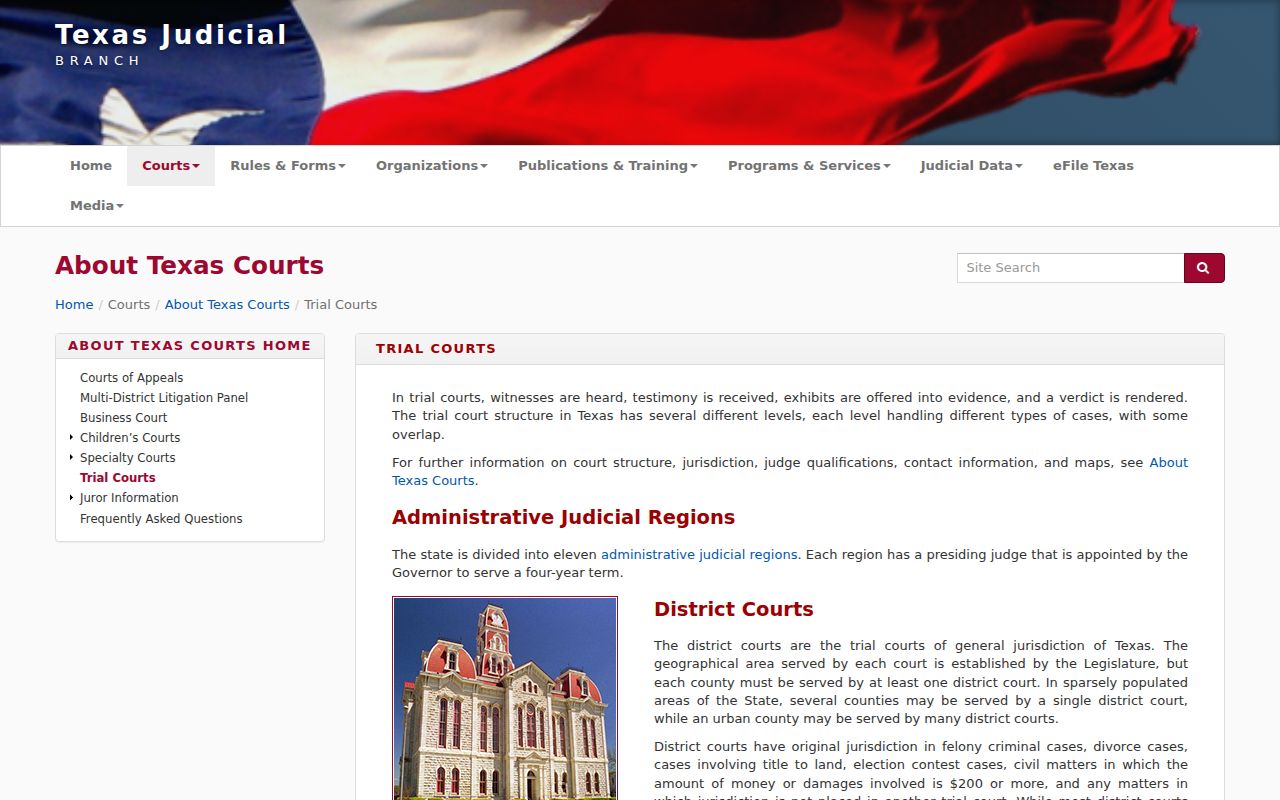
The state overview helps distinguish court levels; local clerks still confirm the actual Hartley case.
Hartley County Bench-Warrant Requests Under PIA
For a copy or existing status record, Hartley County requires a written public-information request sent to the office that holds it. Name the court, case or citation number, record type, and date range. The public instructions do not list a bench-warrant request form, local fee, or promised processing time.
For a possible juvenile case, public access is limited by Texas Family Code §58.010. A records request cannot turn confidential material into a public record. For current status, call the issuing court and ask whether an appearance or hearing remains.
Hartley's written request instructions give the available county submission routes.